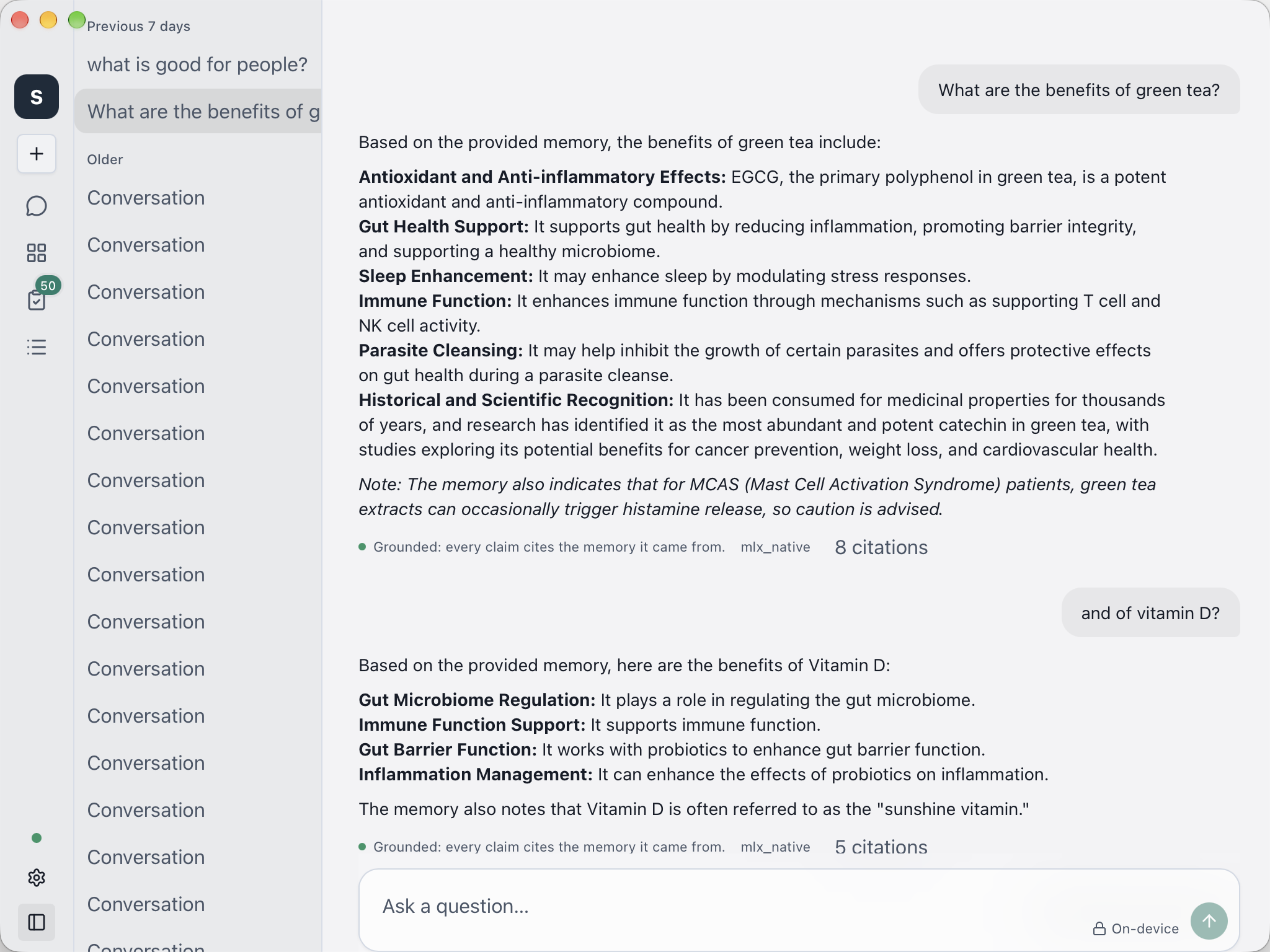
Answers with sources.
Recall returns the document, the revision, and the person who approved it. The model cannot invent a source; the server hands it over.
How recall worksGoverned memory for AI agents
Every answer shows its source. Every change waits for a person. Every decision lands on a record you can check.
Mac app today. Linux and Windows: build from source now, packaged installers are on the way. Build from source
Apache-2.0 · Runs on your hardware · No embedding API
What it does
Recall returns the document, the revision, and the person who approved it. The model cannot invent a source; the server hands it over.
How recall worksAgents propose memories. A human approves the exact text. No approval, no memory. That is the whole gate.
How the gate worksErase a subject and the system hands you a certificate you can re-check any time. Purge, tombstone, live chain check.
How deletion worksRun it
Mac App Store, TestFlight, Homebrew, and Linux packages: planned
git clone https://github.com/stewardmem/stewardmem.git
cd stewardmem
cargo build --release
./target/release/brain-server
One binary, one SQLite file, loopback by default. The Mac app is a client of the same server.
The numbers
Self-measured on our own hardware, with the caveats stated on the trust page. No third-party benchmark yet.
Read the proof map20 ms
p50 recall
8,695-document vault, M1 Pro
25 ms
p95 recall
Same run, 30 samples
166–172 MB
RAM at 1k–5k docs
Ryzen 7 mini PC
0
decision tokens
No LLM in the recall path
Use cases
Not an open-domain one. The Mac app answers questions only from your memory, with citations attached. The server has no chat surface at all; your agent calls it over HTTP, MCP, or the CLI.
No. Recall is deterministic search. A model can propose a memory, but only a person can approve it.
Not by default. The server runs on loopback and stores everything in one local SQLite file. The Mac app runs its model on-device. If you connect a remote model, that is your choice and your data path.
No. It is a posture you set. Trusted pipelines can write directly; turn review on when agents or untrusted sources can propose memory. The developers page shows the exact setting.
No. Erasure is human-only and admin-scoped. An agent can read and propose; it cannot purge.
No. We publish mappings and evidence for frameworks like GDPR, HIPAA, and ISO/IEC 42001. A mapping is not a certificate, and the trust page says exactly what is and is not covered.
No. StewardMem is self-hosted and Apache-2.0. The Mac app is the fastest way to see it work; the quickstart is the fastest way to run the server.
Start here
Grab the Mac app and see it work, or build the server on your own machine. Either way, the record is yours.
Setup takes minutes. The receipts last.